Fund Your Utopia Without Me.™

Showing posts with label debt. Show all posts

01 March 2013

Hedge Fund Icon, Stanley Druckenmiller: "A Storm Is Coming, Maybe Bigger Than The Storm We Had In 2008, 2010."


Hedge fund icon Stanley Druckenmiller sat down with Bloomberg TV's Stephanie Ruhle, saying that he’s decided to speak out now because he sees "a storm coming, maybe bigger than the storm we had in 2008, 2010." His fear is that the ballooning costs of Social Security, Medicare and Medicaid (which with unfunded liabilities are as high as $211 trillion) will bankrupt the nation's youth an pose a much greater danger than the debt currently being debated in Congress.  He said, "While everybody is focusing on the here and now, there's a much, much bigger storm that's about to hit... I am not against seniors. What I am against is current seniors stealing from future seniors." While not exactly Maxine Waters' sequestration-based 170 million job loss, this concerning interview is must-see for his clarity and forthrightness from who is to blame, to the consequences of gridlock, our society's short-term thinking, and the concerning demographics the US faces.


Druckenmiller on why he's speaking out now:

"I see a storm coming, maybe bigger than the storm we had in 2008, 2010.  And really, the reason could happen without people looking as for a lot of similar reasons that we could get into.  But  the basic the basic story is, the demographic bubble I was looking at way back in '94 that started in 2011, we are right at the first ramp-up of this thing that is about to hit."

On U.S. demographics:

"Something remarkable has occurred since 1994 until now, which is entitlement spending, or let me say transfer payments to be a little more correct.  Transfer payments which were 28% and 60, and were 50% when we were in the budget mess in '94.  Lo and behold, they've gone up to 67% of government outlays.  But they haven't gone up because of demographics. They've gone up because the seniors have a very, very powerful lobby.  They keep getting more and more transfer payments from the youth. But the demographic storm is just starting now. It reminds me of '05 when people just extrapolated housing prices going up for 50 years…Everyone sorta lives with their rulers in the past and doesn't look at coming changes. So what's going to happen is we now have a working population, this is the way entitlements work, where the current workforce is paying for the benefits of the seniors. And since 2000, we've had about 4.5 to 4.8 workers for every retiree.  By 2050, that number will drop to 2.4 workers per retiree.  Another catchy way to say it is by 2030, the average population of the United States is gonna be older than the average Floridian right now."

On who is going to stop seniors from stealing from the next generation:

"You asked me why I'm here.  And I think people like me and others need to speak out. It's about the future, not about the present where the problem is.  And let me just say one thing.  I am not against seniors, okay.  I love seniors.  Unfortunately I'm going to be one in the not-too-distant futures.  What I am against is current seniors to me stealing from future seniors."


On who should be blamed for hurting the economy:

"It's hard to tell who's going to be blamed-- if we don't act and this occurs…There's plenty of blame to go around. If I had to analyze how do we get into the financial crisis, I would say it started way back in the '90s when then-Chairman Greenspan refused to address the dot-com bubble, came up with some new theory of productivity and therefore we're not going to have a problem, so all these NASDAQ companies who were never going to earn money went to hundreds-of-times earnings and then of course, we had a major bust.  And instead of taking a recession and having the cleanup…they needed an offset. So they created the housing bubble. So now by hindsight, everybody says, 'Well, you had these horrible Wall Street actors,' and I'm sure there were quite a few horrible Wall Street actors.  And I don't doubt that they were part of the problem.  In fact, I know they were part of the problem.  But I also know it was negative real interest rates for 12 outta 20 years that enabled these actors to do the things they were doing and incented, yes, incented them to go out and gamble the way they were gambling."

On gridlock in Washington:

"I'm pretty frustrated.  This sequester thing-- if you just look at how it came about, first of all, every five minutes all the suffering and all this horrible stuff is going to happen in various sectors if this goes through.  But there's three things that are not on the table in the sequester.  I know you're gonna be shocked by this.  Medicare, social security and Medicaid, okay."

On why Medicare, Medicaid and Social Security are not on the table:

"I'm sure it's because of short-term politics.  The problem with politicians is, they really only do have a four-year life cycle.  The rest of us should have the responsibility to look a little further than that ahead.  But yeah, I don't know whether 'mad' is the word.  I'm extremely frustrated by their refusal to deal with this problem. And the sequester thing, I think the president made a deal. It was a deal so they would extend the debt ceiling, which they did, all right.  I am very much for tax reform.  But I don't think it should be part of this particular thing and we should be parading out the crowd we'd been parading about to say how horrible this is going to affect the economy. Let me tell ya, I don't know what the economy's going to do.  But it's just a little ridiculous to say a $600 billion tax increase over ten years and $150 billion increase in the payroll tax is going to have no affect on the economy.  But an $85 billion cut in discretionary spending is going to tank the economy?  If the economy were to soften, I can tell you it won't be because it will not be because of this $85 billion."

On why he doesn't become a policymaker:

"Because my wife loves New York and I love my wife."


On equities vs. bonds:

One of the things that is kinda one of my pet peeves is hearing all these people on TV say, 'Well, you gotta go into equities 'cause they're so cheap relative to bonds and there's no other game in town.'  They are cheap relative to bonds.  But everything is cheap relative to bonds…So just because equities are cheap relative to bonds doesn't mean their price isn't subsidized.  I'm not making a forecast here because the subsidization could go on for a long time.  But real estate, gold, equities, they're all priced off of ZIRP, zero interest rates, and they're all subsidized."

On whether the hedge fund industry could be in hot water 12-24 months from now and become even further consolidated:

"Oh, I don't know.  I think the hedge fund's short-term thinking is just a manifestation of our entire society.  Whether it's the fed or whether it's-- the administration or whether it's Congress, no one bothers to think about the long term anymore.  And the hedge funds are just one more manifestation of that."

On where investors should put their money right now:

"That's hard for me to answer.  Because I have the luxury of a lot of experience in sitting in front of a screen.  And I can go into currency markets where it's at a relative price.  So it's the one area where prices aren't subsidized.  And I'm arrogant enough to think I can time these things.  But I don't really know how to answer that question for public invest-- but let me just say that this idea that you've got go plowing into risk because rates are zero, that they will rue the day one day.  The music will stop.  And I would probably be invested right now thinking I'm smart enough to know that we're quite away from the music stopping.  I don't think Bernanke is about to end these policies for a while.  But let's just know what we're dealing with here."


On whether there needs to be more consolidation in the banking industry:

"I'd like to see them be more like utilities.  I could care less whether they make money, unless I happen to own equities in it.  But if we're talking about as a United States citizen--I have no problem with banks being utilities and going back to what banks used to do…"

On whether banks should just be making loans:

"Yeah."

On whether the most sophisticated bankers should work at hedge funds, not on sell-side trading desks:

"You said it, Stephanie, not me."

On what his future looks like:


"I'm probably going to disappear again at some point.  But in the meantime, I'm gonna do what I can to try and bring the awareness of this issue out because with respected economists, again, focusing on a little problem over here when you've got this big problem over here, I think the message needs to be out there."


On whether he'll start tweeting:

"No tweeting for me."


http://tinyurl.com/d4v8mb2


23 February 2013

As The Debt Star Looms, The Chicken Littles Scream 'The Sequester Is Nigh!'


“Already, some in Congress are trying to undo these automatic spending cuts. My message to them is simple: No. I WILL VETO ANY EFFORT TO GET RID OF THOSE AUTOMATIC SPENDING CUTS TO DOMESTIC AND DEFENSE SPENDING. There will be no easy off ramps on this one.”
- President Barack Obama, 21 November 2011


In the short term, the good news is that there’s going to be a forcing mechanism to deal with what is the central ideological argument in Washington right now, and that is: How much government do we have and how do we pay for it?  So when you combine the Bush tax cuts expiring, THE SEQUESTER IN PLACE, the commitment of both myself and my opponent — at least Governor Romney claims that he wants to reduce the deficit — but we’re going to be in a position where I believe in the first six months we are going to solve that big piece of business.”


- President Barack Obama, Des Moines Register, 23 October 2012


The Pinocchio Test

No one disputes the fact that no one wanted sequestration, or that ultimately a bipartisan vote in Congress led to passage of the Budget Control Act. But the president categorically said that sequestration was “something that Congress has proposed.”

Woodward’s detailed account of meetings during the crisis, clearly based on interviews with key participants and contemporaneous notes, make it clear that sequestration was a proposal advanced and promoted by the White House.

In sum: Gene Sperling brought up the idea of a sequester, while Jack Lew sold Harry Reid on the idea and then decided to use the Gramm-Hollings-Rudman language (which he knew from his days of working for Tip O’Neill) as a template for sequester. The proposal was so unusual for Republicans that staffers had to work through the night to understand it.

Oddly, Lew in Tampa on Thursday, publicly asserted the opposite: “There was an insistence on the part of Republicans in Congress for there to be some automatic trigger…. [It] was very much rooted in the Republican congressional insistence that there be an automatic measure at the end.”
This prompted Woodward to go over his notes and interviews once again, to make sure he had gotten it right.

“After reviewing all the interviews and the extensive material I have on this issue, it looks like President Obama told a whopper,” Woodward said. “Based on what Jack Lew said in Florida today, I have asked the White House to correct the record.”

We had been wavering between Three and Four Pinocchios. But in light’s of Lew’s decision to doubledown on Obama’s claim, we agree it’s a whopper. 

Four Pinocchios


'I was for SequesterSquatch before I was against it!' 

- President Barack Obama


In FY2001, the government spent $1.8629 trillion. In FY2012, the Federal government spent $3.7956 trillion


That’s a 103.74684631% increase in Federal spending since FY2001!


Pension Spending By The Feds:


2001:    $475.1 billion
2002:   $497.0 billion
2003:   $510.5 billion
2004:   $530.8 billion
2005:   $557.7 billion
2006:   $586.0 billion
2007:   $628.3 billion
2008:   $659.8 billion
2009:   $730.4 billion
2010:    $749.6 billion
2011:     $775.6 billion
2012:    $819.7 billion


That’s a 72.5320985% increase in pension expenses since 2001.


Healthcare Spending By the Feds:


2001:    $389.6 billion
2002:   $427.4 billion
2003:   $469.0 billion
2004:   $509.5 billion
2005:   $549.2 billion
2006:   $582.6 billion
2007:   $641.8 billion
2008:   $67.14 billion
2009:   $764.4 billion
2010:    $820.7 billion
2011:     $858.2 billion
2012:    $846.1 billion


That’s a 117.1714579% increase in healthcare expenditures since 2001.


Education Spending By The Feds:


2001:    $63.6 billion
2002: 
  $77.8 billion
2003:
   $90.5 billion
2004: 
  $96.4 billion
2005: 
  $106.4 billion
2006: 
  $127.6 billion
2007: 
  $100.8 billion
2008: 
  $100.9 billion
2009: 
  $89.8 billion
2010:  
  $139.4 billion
2011:   
  $113.7 billion
2012:  
  $153.1 billion


 The Feds have increased spending on education by 140.72327044% since 2001.


Defence Spending By The Feds (keep in mind that the Iraq War is over):


2001:    $366.2 billion  
2002:   $421.7 billion
2003:   $482.9 billion
2004:   $542.4 billion
2005:   $600.0 billion
2006:   $621.1 billion
2007:   $652.6 billion
2008:   $729.6 billion
2009:   $794.0 billion  
2010:    $847.2 billion  
2011:     $878.5 billion
2012:    $902.0 billion


That’s a 146.31348989% increase in defence spending since 2001.


Welfare Spending By The Feds:


2001:     $188.8 billion
2002:    $229.4 billion
2003:    $249.5 billion
2004:    $244.4 billion
2005:    $252.5 billion
2006:    $254.2 billion
2007:    $262.1 billion
2008:    $322.3 billion
2009:    $415.1 billion
2010:     $502.3 billion
2011:      $472.9 billion
2012:     $451.9 billion


In the past 12 years, the Feds have spent $3.8454 trillion on welfare or $320.5 billion on average each year.  


The Feds have increased overall welfare spending by 139.35381355% since 2001.


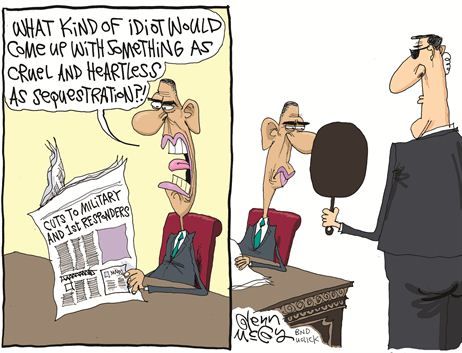
 Political Cartoons by Glenn McCoy


Fed’s Spending on “Protection”:


2001:    $30.2 billion
2002:   $35.1 billion
2003:   $35.3 billion
2004:   $45.6 billion
2005:   $40.0 billion
2006:   $41.0 billion
2007:   $42.4 billion
2008:   $48.1 billion
2009:   $52.6 billion
2010:    $54.4 billion
2011:     $56.1 billion
2012:    $62.0 billion


The Feds have increased overall “protection” spending by 105.29801324% since 2001.


Transportation Spending By The Feds:


2001:    $54.4 billion
2002:   $61.8 billion
2003:   $67.1 billion
2004:   $64.6 billion
2005:   $67.9 billion
2006:   $70.2 billion
2007:   $72.9 billion
2008:   $77.6 billion
2009:   $84.3 billion
2010:    $92.0 billion
2011:     $93.0 billion
2012:    $102.6 billion


That’s a 88.60294117% increase in transportation spending since 2001.


General Government Spending:


2001:    $16.1 billion
2002:   $17.8 billion
2003:   $24.9 billion
2004:   $23.4 billion
2005:   $19.8 billion
2006:   $19.5 billion
2007:   $19.8 billion
2008:   $20.8 billion
2009:   $23.0 billion
2010:  
  $24.7 billion
2011:   
  $29.0 billion
2012:  
  $33.6 billion


 The Feds have increased overall general government spending by 108.69565217% since 2001.


"Other" Spending:

2001:    $72.6 billion
2002:   $72.1 billion
2003:   $77.1 billion
2004:   $75.5 billion
2005:   $94.4 billion
2006:   $126.2 billion
2007:   $71.0 billion
2008:   $99.3 billion
2009:   $377.1 billion
2010:    $29.7 billion
2011:     $96.3 billion
2012:    $199.6 billion

$1.3909 trillion was spent on "other spending" in 12 years or $115.91 billion per year.  


"Other spending" expenditures have increased by 174.93112947% in the last dozen years.


Interest Spending:

2001:     $206.2 billion
2002:    $170.9 billion
2003:    $153.1 billion
2004:    $160.2 billion
2005:    $184.0 billion
2006:    $226.6 billion
2007:    $237.1 billion
2008:    $252.8 billion
2009:    $186.9 billion
2010:     $196.2 billion
2011:      $230.0 billion
2012:     $224.8 billion


We've spent  $2.4288 TRILLION on debt service in the last 12 years or an average of $202.4 billion a year...and, that's been during  a period of historically-low interest rates!


Deficit:

2001:     $17.91 billion
2002:    $157.8 billion
2003:    $377.6 billion 
2004:    $412.7 billion
2005:    $318.4 billion
2006:    $248.2 billion
2007:    $160.7 billion
2008:    $458.6 billion
2009:    $1,412.7 billion
2010:     $1,293.5 billion
2011:      $1,299.6 billion
2012:     $1,327.0 billion


Our deficit has increased by 7309.26856504% in a dozen years!!!


Total Spending:

2001:     $1.8629 trillion
2002:    $2.0109 trillion
2003:    $2.1599 trillion
2004:    $2.2928 trillion
2005:    $2.4720 trillion
2006:    $2.6551 trillion
2007:    $2.7287 trillion
2008:    $2.9825 trillion
2009:    $3.5177 trillion
2010:     $3.4562 trillion
2011:      $3.6031 trillion
2012:     $3.7956 trillion


That’s a 103.74684631% increase in Federal spending in 12 years!


Gross Public Debt:

2001:     $5.7699 trillion 
2002:    $6.1984 trillion
2003:    $6.7600 trillion
2004:    $7.3547 trillion
2005:    $7.9053 trillion
2006:    $8.4514 trillion
2007:    $8.9508 trillion
2008:    $9.9861 trillion
2009:    $11.8759 trillion
2010:     $13.5288 trillion
2011:      $14.6742 trillion
2012:     $16.3509 trillion

That's a 183.3827276% increase in the Federal Government's Gross Public Debt in 12 years!


"The U.S. fiscal gap, calculated (by us) using the Congressional Budget Office’s realistic long-term budget forecast -- the Alternative Fiscal Scenario -- is now $222 trillion. Last year, it was $211 trillion. The $11 trillion difference -- this year’s true federal deficit -- is 10 times larger than the official deficit and roughly as large as the entire stock of official debt in public hands.

This fantastic and dangerous growth in the fiscal gap is not new. In 2003 and 2004, the economists Alan Auerbach and William Gale extended the CBO’s short-term forecast and measured fiscal gaps of $60 trillion and $86 trillion, respectively. In 2007, the first year the CBO produced the Alternative Fiscal Scenario, the gap, by our reckoning, stood at $175 trillion. By 2009, when the CBO began reporting the AFS annually, the gap was $184 trillion. In 2010, it was $202 trillion, followed by $211 trillion in 2011 and $222 trillion in 2012.

When fully retired, 78 million baby boomers will collect, on average, more than 85 percent of per-capita gross domestic product ($40,000 in today’s dollars) in Social Security, Medicare and Medicaid benefits. Each passing year brings these outlays one year closer, which raises their present value.

Governments, like households, can’t indefinitely spend beyond their means. They have to satisfy what economists call their “intertemporal budget constraint.” The fiscal gap simply measures the extent to which this constraint is violated and tells us what is needed to balance the government’s intertemporal budget.

The answer for the U.S. isn’t pretty. Closing the gap using taxes requires an immediate and permanent 64 percent increase in all federal taxes. Alternatively, the U.S. needs to cut, immediately and permanently, all federal purchases and transfer payments, including Social Security and Medicare benefits, by 40 percent. Or it can mix these terrible fiscal medicines with honey, namely radical fiscal reforms that make the economy much fairer and far stronger. What the government can’t do is pay its bills by spending more and taxing less. America’s children, whose futures are being rapidly destroyed, are smart enough to tell us this."

- Laurence Koklikoff and Scott Burns, Blink! U.S. Debt Just Grew by $11 Trillion, Bloomberg,  8 August 2012


" To restrain the U.S.’s future budget crisis, the federal government must raise taxes by at least 35% and cut entitlements such as health care and Social Security by 35%, according to International Monetary Fund economists."


"Eventually we do have a problem. The population is getting older, health care costs are rising ... . Something is going to have to give.  We won't be able to pay for the kind of society we want without some increases in taxes and surely in the end it will require some middle-class taxes as well, maybe a value added tax.  That's not all. We're also going to have to ... really make decisions about health care, (and) not pay for health care that has no demonstrated medical benefits.  Death panels and sales taxes is how we do this."


- Paul Krugman, speech at Sixth & I Historic Synagogue in Washington, D.C, January 2013


"Somebody has to tell the middle class that either your taxes are going to go up or your programs are going to get cut or else we're going to go into financial oblivion, and nobody really wants to tell them that.”

- Howard Dean, February 2013


I've been trying to tell you, LoInFo dolts, that you cannot have this massive welfare state and expect only the wealthy to pay for it.


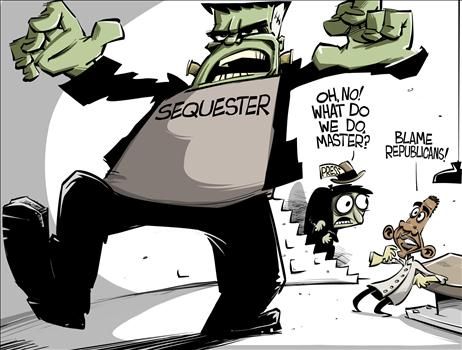
 Political Cartoons by Eric Allie


"It's not my fault!  It's Bush's Republican's fault!"


http://tinyurl.com/ahcsfnz