Fund Your Utopia Without Me.™

17 November 2012

The Wages of 6 November 2012


M2RB:  Led Zepplin


From the houses of the holy, we can watch the white doves go.
From the door, comes Satan's daughter and it only goes to show, you know...

There's an angel on my shoulder, in my hand a sword of gold....


Here Comes Hamas...and Egypt.

Heckava job, Barry!


By Andrew C. McCarthy


The day of reckoning is here.
For over 30 years, the United States government and the institutions that drive public opinion have made like Susan Rice when it comes to the ideological threat that Islamic supremacists pose to freedom, fabricating reasons to remain in denial. Thus inured, the American people have elected, and now reelected, a president notoriously fond of America-bashing Islamists. The attraction would not be hard to understand if we were not so ideology-averse — GOP strategists having made Obama’s radicalism a subject nearly as off-limits as Islamic supremacism, helpfully leaving the Left to fill the canvas with their portrait of Mitt Romney: “Where Gordon Gekko Meets Michael Vick.”

The president is a movement leftist who sees in our society a condemnable legacy of racism, imperialism, and economic exploitation that cries out for “fundamental change.” That is not meaningfully different from the Islamist perspective of America: The Brotherhood’s self-proclaimed mandate to “eliminate and destroy Western civilization from within” by “sabotage” is, in effect, a cognate summons to “fundamental change,” even allowing that Islamists are driven to statism by sharia rather than Marxism. The Brotherhood’s American mouthpiece, the Council on American-Islamic Relations, brags that the president nabbed 85 percent of the Muslim vote on November 6 — larger even than Obama’s lopsided share of the Hispanic vote, which has GOP strategists hyperventilating. You wouldn’t want to take CAIR claims at face value, but their ardor for Obama, like the Brotherhood’s, is palpable. And as we’ve seen for four years, it is not an unrequited love.

So along comes Hamas. Just days before the presidential election, the terrorist organization — begotten by the Brotherhood and serving as its Palestinian branch — spearheaded an Islamist offensive, firing in just a few days over 120 rockets into the Jewish state from its home base in Gaza. You may not have heard about it until a few days after the election. Like Iran’s act of war in shooting at a U.S. drone in international waters, it signaled a further dangerous unraveling of the Middle East that undercut the media narrative of Obama as foreign-policy chess master, so it was tucked under the rug. But it could not be ignored forever, for it is not just another spike in the ever-thrumming Gaza border skirmish. It is the renewal of an unending war — an existential one for Israel, which is expected to fight “proportionately,” with both hands tied behind its back, yet blithely accept, as the international community has, the barbaric Islamist claim that nothing short of Israel’s destruction will be satisfactory. By its own declaration, Hamas will be at war with Israel until the latter’s demise. Toward that end, the jihad has now been taken to population centers such as Tel Aviv. As of this writing, the Israeli death toll stands at three, kept low only by the crudeness of the jihadist weapons and tactics.

By the calculation of terrorism analyst Ryan Mauro, the onslaught begun last week brought the yearly total of missile attacks on Israel to about 700. That is, while the Obama administration has been facilitating the Muslim Brotherhood’s rise in Egypt, Tunisia, Libya, and soon Syria — with Obama drawing ever closer to Turkey’s Islamist prime minister, Recep Tayyip Erdogan, even as Erdogan champions and funds Hamas — Gaza’s jihadists have been emboldened to step up their terror campaign.

And it is not just Gaza’s jihadists. Understand: This is not Hamas’s war of extermination against Israel. It is Islam’s. And yes, for the millionth time, there are various ways of interpreting Islam, but the Islam that matters in the Middle East, the Islam that animates tens of millions of Muslims, is Islamic supremacism. Israel, the canary in the West’s coal mine, is not besieged by an eccentric doctrine weaved by Hamas, Hezbollah, and al-Qaeda. Jihadist terrorists are just the point of the ideological spear.


Recent polling shows that four in five Egyptians (i.e., about 60 million people) believe the Camp David Accords — the treaty that has kept peace between Egypt and Israel for 30 years — should be dissolved. It is the same four out of five Egyptians that, given the chance, voted to put Islamists in control of their government. Just as Muslims have chosen to empower Islamists in Turkey, Gaza, Iraq, Afghanistan, and Tunisia, as well as in Lebanon and Libya to a lesser but still consequential extent. The jihad against Israel “isn’t a matter of individuals, not a matter of community. It is a matter of a nation. The Arab nation, the Islamic nation.” So exclaimed Egyptian prime minister Hisham Qandil on Thursday in Gaza. He had been sent there to show solidarity with Hamas by Mohamed Morsi, the Brotherhood leader Egyptians elected as their president. “We are all behind you,” Qandil continued — behind “the struggling nation . . . that is presenting its children as heroes every day.”

This is how the Middle East’s Muslims see the situation. They are not Palestinians, Egyptians, Saudis, Iraqis, and so on. They are the ummah, the “Islamic nation.” For them, Gaza is not a regional dustup over parochial grievances. It is a civilizational struggle to be fought to the finish — the finish being when the enemy is vanquished. We used to fight wars that way, too. The fact that we’ve decided total victory by force of arms is a quaint concept does not mean everybody else has. Islamists define victory in the Middle East as the annihilation of Israel. That is the ambition of the region, not just of Hamas. Our government’s decades-old claim that the aggression results from a “perversion of Islam” weaved by a fringe of “violent extremists” is dangerously delusional.

Delusion, of course, is nothing new. For 30 years, ever since the Carter administration hailed Ayatollah Khomeini as a “saint,” willful blindness has been the order of the day. It induced the Clinton and George W. Bush administrations to insist that Islam was a “religion of peace” even as scripture-citing Islamists repeatedly mass-murdered Americans. But Barack Obama is something else again. This president has supplanted conscious avoidance of our enemies’ ideology with empathy. Our government no longer just ignores Islamist goals; it affirmatively empowers Islamist factions.

It has been only eleven days, but we’re already seeing the wages of November 6. The world has become a much more dangerous place, and not just for Israelis.


— Andrew C. McCarthy is a senior fellow at the National Review Institute and the executive director of the Philadelphia Freedom Center. He is the author, most recently, of Spring Fever: The Illusion of Islamic Democracy, which was published by Encounter Books.


Houses Of The Holy - Led Zepplin

Let me take you to the movies. Can I take you to the show
Let me be yours ever truly. Can I make your garden grow

From the houses of the holy, we can watch the white doves go

From the door comes Satan's daughter, and it only goes to show. You know.

There's an angel on my shoulder, In my hand a sword of gold

Let me wander in your garden. And the seeds of love I'll sow. You know.

So the world is spinning faster. Are you dizzy when you're stoned

Let the music be your master. Will you heed the master's call
Oh... Satan and man.

Said there ain't no use in crying. Cause it will only, only drive you mad

Does it hurt to hear them lying? Was this the only world you had? Oh-oh

So let me take you, take you to the movie. Can I take you, baby, to the show.

Why don't you let me be yours ever truly. Can I make your garden grow
You know.


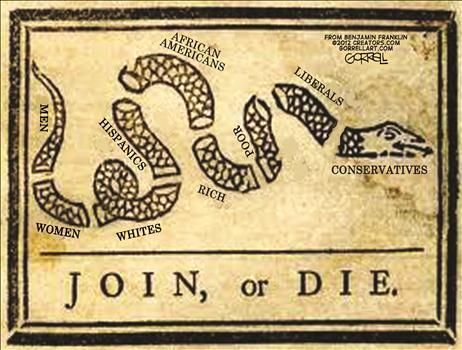
'Toon of the Day: Join, or Die.


New Hotness:


Political Cartoons by Bob Gorrell


Old & Busted:


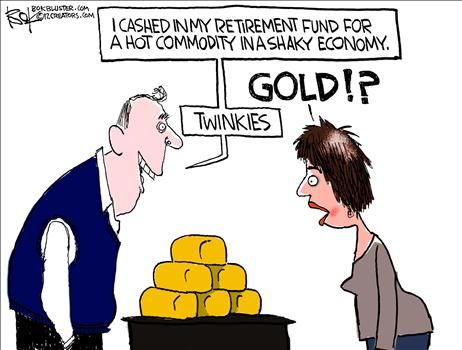
The Hostess Liquidation: A Curious Cast Of Characters As The Twinkie Tumbles


Political Cartoons by Chip Bok


By Taylor Durden


Perhaps one of the most interesting aspects of the just announced Hostess liquidation, one that will be largely debated and discussed in the media, or maybe not at all, is the curious cast of characters and the peculiar history of this particular bankruptcy. Some may not be aware that the company's Chapter 11 (or colloquially known as 22) bankruptcy filing this January, which today became a Chapter 7 liquidation, was the second one in the company's recent history, with Hostess, previously Interstate Bakeries, emerging from its previous protracted multi-year bankruptcy in 2009. What is curious is that its emergence had all the drama of an anti-Mitt Romney PAC funded thriller, with a PE firm, in this case Ripplewood holdings, injecting $130 million in order to obtain equity control of Hostess as it was emerging last time. There were also more hedge funds, investment banks, strategic buyers, politicians involved in this particular story than one can shake a deep fried numismatic value Twinkie at. More importantly, however, as America has been habituated following the last season of the reality TV show known as the presidential election, if Private Equity then "bad." Only this time there is a twist: because it wasn't really PE that was the pure evil in the Obama long-term campaign, it was associating PE with Republicans, and thus: with jobs outsourcing. And here comes the Hostess twist: because Tim Collins of Ripplewood, was a prominent Democrat, a position which allowed him to get involved in the first bankruptcy process in the first place, due to his proximity with the Teamsters' long-term heartthrob Dick Gephardt (whose consulting group just happens to also be an equity owner of Hostess). In other words, the traditional republican-cum-PE scapegoating strategy here will be a tough one to pull off since the narrative collapses when considering that it was a Democrat who rescued the firm, only to see it implode in a trainwreck that has resulted in the liquidation of a legendary brand, and 18,500 layoffs.

But it only gets better. Because the full cast of characters involved here is quite stunning, as David Kaplan summarized so well recently:


Ripplewood is run by Tim Collins, 55, who's been at the center of other famed PE transactions. Known as a brilliant capitalist-philanthropist-networker, he's an eclectic character: a Democrat in an industry of Republicans; an Adirondack enthusiast dreaded by pheasant and fish; a board member at the Yale divinity and business schools; and someone who took a year at 31 to work at a refugee camp in the Sudan. Ripplewood orchestrated the $1.1 billion turnaround in 2000 of the Long-Term Credit Bank of Japan, which marked the first time that foreign interests controlled a Japanese bank. (Collins made the cover of Fortune Asia for it.) The bank was renamed Shinsei, and in 2004 it had a lucrative initial public stock offering. Far less fortunately, in 2007 Ripplewood acquired Reader's Digest -- and saw its $275 million investment vanish in Reader's Digest's bankruptcy filing in 2009. (Collins reportedly had visions of merging Reader's Digest with the magazine division of Time Warner (TWX), which owns Fortune.)

Ripplewood's foray into Hostess was partly enabled by Collins's connections in the Democratic Party. He wanted to explore deals with union-involved companies and sought the help of former Democratic Congressman Dick Gephardt, who in 2005 founded the Gephardt Group, an Atlanta consulting firm that provides "labor advisory services." In his 2004 presidential bid, Gephardt -- whose father was a Teamsters milk truck driver -- was endorsed by 21 of the largest U.S. labor unions; in 2003, Collins was one of 19 "founding members" of Gephardt's New York State leadership committee. (Today, Ripplewood and Hostess are listed online as major clients of Gephardt's consulting group, which is also an equity owner of Hostess.) Back when Hostess was coming out of the first bankruptcy, Gephardt's credibility with both Ripplewood and the Teamsters gave them each a little more room to break bread.

During this first bankruptcy, Hostess was almost sold. In 2007 it warded off a $580 million bid from its biggest competitor, Bimbo Bakeries USA. Bimbo Bakeries USA is part of Grupo Bimbo, the Mexican baking giant that owns such brands as Sara Lee, Entenmann's, Freihofer's, Arnold, Boboli, Ball Park Buns, and Thomas' English Muffins. Joining Bimbo in the bid were the union-friendly investment arm of supermarket titan, (huge Democratic fundraiser and bundler) Ron Burkle and the Teamsters themselves.

Hostess was able to exit bankruptcy in 2009 for three reasons. The first was Ripplewood's equity infusion of $130 million in return for control of the company (it currently owns about two-thirds of the equity). The second reason: substantial concessions by the two big unions. Annual labor cost savings to the company were about $110 million; thousands of union members lost their jobs. The third reason: Lenders agreed to stay in the game rather than drive Hostess into liquidation and take whatever pieces were left. The key lenders were Silver Point and Monarch. Both are hedge funds that specialize in investing in distressed companies -- whether you call them saviors or vultures depends on whether you're getting fed or getting eaten.

Based in Greenwich, Conn., Silver Point was founded in 2002 and has approximately $6.5 billion under management; its two co-founders are 49-year-old Edward Mulé and 47-year-old Robert O'Shea, both former Goldman Sachs (GS) partners. Silver Point helped bail out Krispy Kreme Doughnuts, Delphi, CIT Group, and various TV stations. Monarch, based in Manhattan, was created in 2008 as a spinoff from the Quadrangle Group. It reportedly has more than $3 billion under management; among its three co-founders are 52-year-old Michael Weinstock and 48-yearold Andrew Herenstein, both formerly of Lazard. Monarch has invested in Eddie Bauer and the Texas Rangers. (In 2010, after Herenstein sent a letter to baseball teams warning them not to approve a sale of the Rangers "at a price below fair market value," the letter became public, and the Dallas Morning News ran this ominous blog headline: MONARCH ALTERNATIVE CAPITAL THREATENS BASEBALL.)

Silver Point and Monarch, along with about 20 other lenders, owned about $450 million of Hostess secured debt at the time of the bankruptcy filing in 2004, according to court records. Remarkably, though -- given that Hostess's financials are now supposed to be an open book in federal bankruptcy court -- it's unclear how much the lenders actually paid for those notes. But it's presumably less than face value. Opportunistic investors like Silver Point and Monarch commonly buy distressed debt at a considerable discount. Their strategy: Invest in fundamentally "good" companies that have "bad" capital structures brought about by overborrowing, bankruptcy, or other corporate stresses.

Neither the specific amount put up by each investor nor the percentage of the total debt is public record (In re Hostess Brands, Case No. 12-22052). So it's impossible to know for sure how much "skin in the game" the creditors have. But according to sources with knowledge of Hostess's debt structure, Silver Point owns about 30% of the debt; Monarch, also about 30%; and the other lenders combined own the remaining 40%. Clearly, it was Silver Point and Monarch, along with Ripplewood, that had the biggest bets going forward.


Confused yet? Here it is summarized in a schematic:


http://www.zerohedge.com/sites/default/files/images/user5/imageroot/2012/11/Hostess%20Wars.jpg


The rest of the story is your typical post-emergency NewCo gone horribly wrong with a prominent role for the Snafu here reserved to Hostess restructuring banker Miller Buckfire for not cutting enough of the firm's pre-petition debt, with the straw that broke the camel's back being, what else, unfunded pension liabilities. As was explained back in July:


The critical issue in the bankruptcy is legacy pensions. Hostess has roughly $2 billion in unfunded pension liabilities to its various unions' workers -- the Teamsters but also the Bakery, Confectionery, Tobacco Workers and Grain Millers International Union (which has largely chosen not to contest what Hostess wants to do -- that is, to get out of much of that obligation). If the bankruptcy court lets Hostess off the pension hook -- which often happens in these cases -- it only moves the struggle outside the courthouse, and the ante goes up. For the Teamsters can then call a strike -- which its Hostess employees have already ratified by a 9-to-1 margin. If the court doesn't grant relief, Hostess can seek liquidation, which would mean that some creditors get some money, but equity would be gone for good, as would a lot of jobs. Either way, each side holds a nuclear warhead with which to annihilate the company.


Liquidation is what ended up happening, as no compromise was possible, and the magic money tree, primarily as a result of equityholders (and creditors) refusing to inject any more cash.


Yet while the balance sheet burden was certainly the pension liabilities, what precipitated the liquidation was the income statement, and more accurately, the cash flow statement, or specifically the lack of cash flow.

As the company tried to reinvent itself in 2009 and 2010, external currents were running against it. The Great Recession hurt many consumer brands generally, and the prices of the commodities that Hostess relied on -- corn, sugar, flour -- went up, which is the opposite of what's supposed to happen in a downturn. In addition, the bakery industry underwent more consolidation when Sara Lee sold out to Bimbo.

Those fortuities aggravated Hostess's two root problems -- a highly leveraged capital structure that had little margin of safety, and high labor costs. Neither problem was adequately addressed in the first bankruptcy, and neither existed to the same degree in major competitors like Bimbo and Flowers Food (owner of such brands as Nature's Own and Tastykake). On exiting the first bankruptcy, Hostess's total debt load was nearly $670 million. That was well above what it went into bankruptcy with in the first place -- an unusual circumstance that the company justified on expectations of "growing" into its capital structure.

But the company was dead wrong. Its debt sowed the very seeds of the next bankruptcy. Looking back on the decision to reinvest in Hostess in the first bankruptcy, one of the lenders now says, "If you look in the dictionary at the definition of throwing good money after bad, there should be a picture of Hostess beside it."

By late 2011, Hostess was getting, well, creamed. Its sales last year -- $2.5 billion -- were down about 11% from 2008 and down 28% from 2004. (Twinkies remain the best individual seller -- 323 million of them in the 52-week period ending June 29, give or take a splurt.) Overall, Hostess lost $341 million in fiscal 2011, 2½ times the loss of the prior year -- and by early 2012, primarily because of burgeoning interest obligations, its debt had grown to about $860 million.

As revenue declined, the company continued to burn cash -- in the second half of 2011, the rate was $2 million a week. The liquidity crunch forced Ripplewood in the early spring of 2011 to pump in $40 million more in return for more equity as well as debt that was subordinate to that held by Silver Point and Monarch. In August -- to save a company teetering on the edge of fiscal calamity and forced liquidation -- Silver Point, Monarch, and the group of other lenders put up an additional $30 million to see if a negotiated turnaround was possible.

They turned to the unions and demanded new concessions. But the unions, having three years earlier given up thousands of jobs and millions in benefits, flatly refused.

The company was going to pieces -- again -- and Hostess filed for Chapter 11 protection -- again -- in January of this year. This time, though, the moneymen were no longer on the same page. As the majority equity holder, Ripplewood badly wanted to keep Hostess out of bankruptcy. It pleaded with the lenders to show flexibility, but they were not so inclined. They lenders held superior fiscal hands and had less downside if Hostess failed. In the event of a bankruptcy, given all the assets Hostess owned, the lenders would still walk away with millions.


There is much more to this story, but the ending is well-known to all, and it is not a happy one.

End result: a near total loss for everyone involved, except the secured creditors of course, who will now get pennies on the dollar, or perhaps even par, for their claims when all is said and done.

Sadly, in many ways Hostess is now indicative of that just as insolvent larger corporation, the USA, whose insurmountable balance sheet liabilities will be the eventual catalyst for its collapse, but only once the Income Statement and the Cash Flow sheet join in. For now, the Fed provides the flow needed to avoid the day of reckoning, but everything ends eventually.

In the meantime, what the Hostess story will hopefully teach the always gullible public, is that nothing is ever black or white, and there are numerous shades of gray in every story: even one in which an "evil" PE firm is unable to come to resolution with labor unions, despite the man in charge of it all being a prominent democrat. Because when it comes to money other things such alliances, ideology and certainly politics are always, always, secondary. Sadly, ever more Americans will be forced to learn this lesson the hard way.

16 November 2012

Tribal America


M2RB:  Blue Öyster Cult  (cowbell link)


40,000 men and women everyday...Redefine happiness
Another 40,000 coming everyday...We can be like they are
Come on baby...don't fear the reaper
Baby take my hand...don't fear the reaper
We'll be able to fly...don't fear the reaper


By Mark Steyn

To an immigrant such as myself (not the undocumented kind, but documented up to the hilt, alas), one of the most striking features of election-night analysis was the lightly worn racial obsession. On Fox News, Democrat Kirsten Powers argued that Republicans needed to deal with the reality that America is becoming what she called a “brown country.” Her fellow Democrat Bob Beckel observed on several occasions that if the share of the “white vote” was held down below 73 percent Romney would lose. In the end, it was 72 percent and he did. Beckel’s assertion — that if you knew the ethnic composition of the electorate you also knew the result — turned out to be correct. 

This is what less enlightened societies call tribalism: For example, in the 1980 election leading to Zimbabwe’s independence, Joshua Nkomo’s ZAPU-PF got the votes of the Ndebele people while Robert Mugabe’s ZANU-PF secured those of the Shona — and, as there were more Shona than Ndebele, Mugabe won. That same year America held an election, and Ronald Reagan won a landslide victory. Nobody talked about tribal-vote shares back then, but had the percentage of what Beckel calls the “white vote” been the same in 2012 as it was in 1980 (88 percent), Mitt Romney would have won in an even bigger landslide than Reagan. The “white vote” will be even lower in 2016, and so, on the Beckel model, Republicans are set to lose all over again.

Hence the urge to get on the right side of America’s fastest-growing demographic. Only 27 percent of Hispanics voted for Romney. But all that could change if the GOP were to sign on to support some means of legalizing the presence of the 12–20 million fine upstanding members of the Undocumented-American community who are allegedly “social conservatives” and thus natural Republican voters. Once we pass amnesty, argues Grover Norquist’s Americans for Tax Reform, “future immigrants will be more open to the Republican Party because, unlike many immigrants who are already here, they won’t have been harmed or insulted by Republican politicians.”

So, if I follow correctly, instead of getting 27 percent of the 10 percent Hispanic vote, Republicans will get, oh, 38 percent of the 25 percent Hispanic vote, and sweep to victory.

Everyone talks about this demographic transformation as if it’s a natural phenomenon, like Hurricane Sandy. Indeed, I notice that many of those exulting in the inevitable eclipse of “white America” are the same people who assure me that demographic arguments about the Islamization of Europe are completely preposterous. But in neither the United States nor Europe is it a natural phenomenon. Rather, it’s the fruit of conscious government policy.

According to the Census, in 1970 the “Non-Hispanic White” population of California was 78 percent. By the 2010 census, it was 40 percent. Over the same period, the 10 percent Hispanic population quadrupled and caught up with whites.

That doesn’t sound terribly “natural” does it? If one were informed that, say, the population of Nigeria had gone from 80 percent black in 1970 to 40 percent black today, one would suspect something rather odd and unnatural had been going on. Twenty years ago, Rwanda was about 14 percent Tutsi. Now it’s just under 10 percent. So it takes a bunch of Hutu butchers getting out their machetes and engaging in seven-figure genocide to lower the Tutsi population by a third. But, when the white population of California falls by half, that’s “natural,” just the way it is, one of those things, could happen to anyone.

Every four years, the Republican party pines for another Reagan. But Ronald Reagan, governor of California for eight years, couldn’t get elected in today’s not-so-Golden State. Jerry Brown, Governor Moonbeam back in the Seventies, now presides as Governor Twilight, lead vampire of a malign alliance of unionized bureaucrats and a swollen dependency class that maintains them in office at the expense of a remorselessly shrinking productive class. As the nation’s demographic profile trends ever more Californian, perhaps Norquist’s predictions of naturally conservative Hispanics pining for a new Reagan will come to fruition. Or perhaps Bob Beckel’s more crudely determinative analysis will prove correct — that, in a multicultural society, jostling identity groups will stick with the party of ethnocultural spoils.

Once upon a time, the Democrats thought differently. It was their first progressive president, Woodrow Wilson, who imposed the concept of “self-determination” on post–Great War Europe, insisting that the multicultural empires of the Habsburgs and Romanovs be replaced by a patchwork of ethnic statelets from the Balkans to the Baltics. He would be surprised to find his own party presiding over a Habsburgian America of bilingual Balkanization as a matter of electoral strategy. 

The short history of the Western Hemisphere is as follows: North America was colonized by Anglo-Celts, Central and South America by “Hispanics.” Up north, two centuries of constitutional evolution and economic growth; down south, coups, corruption, generalissimos, and presidents-for-life. None of us can know the future. It may be that Charles Krauthammer is correct that Hispanics are natural Republicans merely pining for amnesty, a Hallmark Cinco de Mayo card, and a mariachi band at the inaugural ball. Or it may be that, in defiance of Dr. Krauthammer, Grover Norquist, and Little Mary Sunshine, demographics is destiny and, absent assimilationist incentives this country no longer imposes, a Latin American population will wind up living in a Latin American society. Don’t take it from a right-wing bigot like me, take it from the New York Times. In 2009, Jason DeParle filed a story about suburban Maryland, in which he helpfully explained the municipality of Langley Park to Times readers:
Now nearly two-thirds Latino and foreign-born, it has the aesthetics of suburban sprawl and the aura of Central America. Laundromats double as money-transfer stores. Jobless men drink and sleep in the sun. There is no city government, few community leaders, and little community.
Golly. You’d almost get the impression that Mr. DeParle thinks that laundromats doubling as money-transfer stores, jobless men drinking and sleeping in the sun, and dysfunctional government are somehow characteristic of Central America. That sounds awfully judgmental for a Times man, no?

Republicans think they’re importing hardworking immigrants who want a shot at the American Dream; the Democrats think they’re importing clients for Big Government. 

The Left is right: Just under 60 percent of immigrants receive some form of welfare. I see the recent Republican proposals for some form of amnesty contain all sorts of supposed safeguards against gaming the system, including a $525 application fee for each stage of the legalization process. On my own recent visit to a U.S. Immigration office, I was interested to be told that, as a matter of policy, the Obama administration is now rubberstamping all “fee waiver” requests for “exceptional hardship” filed by members of approved identity groups. And so it will go for all those GOP safeguards. While Canada and Australia compete for high-skilled immigrants, America fast-tracks an unskilled welfare class of such economic benefit to their new homeland they can’t even afford a couple of hundred bucks for the necessary paperwork.

It’s hardly their fault. If you were told you could walk into a First World nation and access free education, free health care, free services in your own language, and have someone else pay your entrance fee, why wouldn’t you? So, yes, Republicans should “moderate” their tone toward immigrants, and de-moderate their attitude to the Dems who suckered the GOP all too predictably. Decades of faintheartedness toward some of the most destabilizing features of any society, including bilingualism (take it from a semi-Belgian Canadian), have brought the party to its date with destiny. Or as Peggy Lee sang long ago in a lost land, “Mañana is soon enough for me.”

— Mark Steyn, a National Review columnist, is the author of After America: Get Ready for Armageddon. © 2012 Mark Steyn


Don't Fear The Reaper - Blue Öyster Cult


All our times have come
Here but now they're gone
Seasons don't fear the reaper
Nor do the wind, the sun or the rain..we can be like they are
Come on baby...don't fear the reaper
Baby take my hand...don't fear the reaper
We'll be able to fly...don't fear the reaper
Baby I'm your man...

Valentine is done

Here but now they're gone
Romeo and Juliet
Are together in eternity...Romeo and Juliet
40,000 men and women everyday...Like Romeo and Juliet
40,000 men and women everyday...Redefine happiness
Another 40,000 coming everyday...We can be like they are
Come on baby...don't fear the reaper
Baby take my hand...don't fear the reaper
We'll be able to fly...don't fear the reaper
Baby I'm your man...

Love of two is one

Here but now they're gone
Came the last night of sadness
And it was clear she couldn't go on
Then the door was open and the wind appeared
The candles blew then disappeared
The curtains flew then he appeared...saying don't be afraid
Come on baby...and she had no fear
And she ran to him...then they started to fly
They looked backward and said goodby...she had become like they are
She had taken his hand...she had become like they are
Come on baby...don't fear the reaper