Fund Your Utopia Without Me.™

26 January 2013

In The End, Will Obama Be The Best Spokesman Against Progressivism?


M2RB:  Eric Clapton


And, I can change the world,
I will be the sunlight in your universe.
You would think my love was really something good,
Baby, if I could change the world.

But for now I find
It's only in my dreams.


Repent, you Coming Ice Age/Global Warming/Global Cooling/Climate Change/Climate Chaos worse-than-Holocaust-deniers deniers, the end is nigh!


We absolutely must install a really big and supa-dupa smart meter on the planet!


By George F Will
 
Happy days are not here again, but they are coming for conservatives. Barack Obama — with the lowest approval rating (according to Gallup, 50 percent, four points lower than that of the National Rifle Association) of any reelected president when inaugurated since World War II — has a contradictory agenda certain to stimulate a conservative revival.

Consider his vow to expend political capital on climate change. The absurdity of the Kyoto approach — global climate treaties agreed to by 190 nations — is now obvious even to most former enthusiasts. Obama can propose cutting U.S. fossil-fuel emissions (just 16 percent of the global total) with a carbon tax or a cap-and-trade scheme, but Congress will pass neither. So he will be reduced to administrative gestures costly to job growth, and government spending — often crony capitalism — for green energy incommensurate with his rhetoric.

He says that “the threat of climate change” is apparent in “raging fires,” “crippling drought” and “more powerful storms.” Are fires raging now more than ever? (There were a third fewer U.S. wildfires in 2012 than in 2006.) Are the number and severity of fires determined by climate change rather than forestry and land-use practices? Is today’s drought worse than, say, that of the Dust Bowl, and was it caused by 1930s global warming? As for “more powerful storms”:

Because Sandy struck New York City, where the nation’s media congregate and participate in the city’s provincialism, this storm was declared more cosmically momentous than the 74 other hurricanes that have hit or come near the city since 1800. In 2005, Hurricane Katrina was called a consequence of global warming and hence a harbinger of increasing numbers of Category 3 or higher hurricanes. Since then, major hurricane activity has plummeted. No Category 3 storm has hit the United States since 2005. Sandy was just a Category 1.

Obama’s vow to adjust Earth’s thermostat followed the report that 2012 was the hottest year on record in the contiguous 48 states. But the Wall Street Journal’s Holman Jenkins, who has concisely posed the actual climate policy choice (“How much should we spend on climate change in order to have no effect on climate change?”), has noted that although 2012 was 2.13 degrees Fahrenheit hotter than 2011, “2008, in the contiguous U.S., was two degrees cooler than 2006.” And “2000, 2002, 2003, 2004, 2008, 2009, 2010 and 2011 were all cooler than 1998 by a larger margin than 2012 was hotter than 1998.” Such is the rigor of many who preen as devotees of science that they declared the 2012 temperatures in the contiguous states (1.58 percent of the Earth’s surface) proof of catastrophic global warming.

A flourishing American economic sector is fossil fuels — especially oil and natural gas — which the Obama administration seems to regret and often impedes (see: fracking and the Keystone XL pipeline). Yet the natural gas boom is one of the main reasons why, in 2012, U.S. fossil-fuel emissions were the lowest since 1992. Obama’s wariness about the pipeline suggests that he subscribes to some environmentalists’ stupendously weird theory: If the pipeline is not built to carry oil from the (supposedly dangerous) development of Canadian tar sands, Canada will leave those sands undeveloped rather than sell the oil to China.

Small businesses create most new jobs, but many businesses are avoiding hiring a 50th employee, or are replacing full-time employees with those working fewer than 30 hours a week, to avoid Obamacare’s costly requirements regarding provision of health insurance. Some colleges and universities are reducing to 29 the number of hours adjunct professors can teach, which is condign punishment for those professors — most of them, surely — who favored Obamacare.

It and other regulatory burdens, combined with the subsidization of not working (47.5 million people receiving food stamps, 8.6 million receiving disability payments, unemployment benefits extended from 26 weeks to 73 weeks — so far), partially explain this fact provided by Richard Vedder of the American Enterprise Institute: “If today the country had the same proportion of persons of working age employed as it did in 2000, the U.S. would have almost 14 million more people contributing to the economy.” Fourteen million is more than the combined workforces of 18 states.

In the rhetorical cotton candy of his inaugural address — sugary, and mostly air — Obama spoke of “investing in” rising generations and said: “America’s possibilities are limitless.” He ignores the encroaching limits imposed on the nation by his policies that are funded by debt that will burden those generations. 


 Change The World - Eric Clapton

If I could reach the stars
Pull one down for you,
Shine it on my heart
So you could see the truth:

That this love inside
Is everything it seems.
But for now I find
It's only in my dreams.

And I can change the world,
I will be the sunlight in your universe.
You would think my love was really something good,
Baby, if I could change the world.

If I could be king,
Even for a day,
I'd take you as my queen;
I'd have it no other way.

And our love would rule
This kingdom we had made.
'til then I'd be a fool,
Wishing for the day...

That I can change the world,
I would be the sunlight in your universe.
You would think my love was really something good,
Baby, if I could change the world.
Baby. if I could change the world.

I could change the world,
I would be the sunlight in your universe.
You would think my love was really something good,
Baby, if I could change the world.


This Time Is Not Different: America Must Face Up To Its Responsibilities


M2RB:  Sinéad O'Connor


 I am not like I was before
I thought that nothing would change me
I was not listening anymore
Still you continued to affect me


This Time Is Not Different:  America Must Face Up To Its Responsibilities

  
By Kenneth Rogoff 

Many foreign observers look at the US budget shenanigans with confusion and dismay, wondering how a country that seems to have it all can manage its fiscal affairs so chaotically. The root problem is not just a hugely elevated level of public debt, or a patently unsustainable trajectory for old age entitlements. It is an electorate deeply divided over the direction of government, with differences compounded by changing demographics and sustained sluggish growth. It is hard to escape the notion that today’s budget battles are but a skirmish in a much longer-term war that won’t be settled soon. 

America must shortly answer a series of fundamental questions. For example, as its share of global gross domestic product shrinks from about 20 per cent today to as little as 10 per cent in five decades, should it try to continue to play the role of global policeman? The US spends more than 4 per cent of GDP a year on defence, roughly twice the global average. The Obama administration’s fiscal plans anticipate a peace dividend after withdrawals from wars in Iraq and Afghanistan. The Republican party has reasonably argued that it is unrealistic to expect this quiet to last. At the very least, if military expenditures continue to fall, it becomes more important to have the fiscal capacity to ramp them up in response to new threats. It is also worth noting that if the US were ever forced to surrender the mantle of world policeman to, say, China, foreigners may no longer have quite the same desire for its debt. 

Another huge area of disagreement surrounds the question of what services should be provided by the federal government versus the states or the private sector. There is a lot of “low-hanging fruit” here. Productivity improvements in government services have been glacial compared with many other sectors of the economy. A visit to a primary school classroom in many US cities is the closest thing one can get to time travel. One idea that economists have been enamoured with for years is school vouchers but there is strong resistance from entrenched interests. How long will these same interests forestall online classes and computer-graded feedback, initially as a supplement for traditional education structures but eventually as a significant substitute. The fiscal implications are huge, as are the disagreements. 

In contrast, infrastructure should be a place of common ground but again there is paralysis. Aside from funding priorities, there is a wide chasm between those who see union domination of infrastructure as key to ensuring high-paying jobs versus those who want infrastructure built, but at reasonable rates. There is the joke about the visiting Chinese group that asks their New York tour guide how long it will take to finish the Second Avenue subway. On being told two years, the Chinese translator hesitates before conveying the response and asks: “Wait a second, you mean two weeks, right?” 

One of the US’s greatest assets is its ability to expand immigration without running into land or resource constraints anytime soon. But US immigration policy has long been dominated by emotion, not the cold-blooded, rational economic calculus many other countries apply. There are rigid visa restrictions aimed at keeping out terrorists, some of which remain incredibly counterproductive. Immigration policy has large implications for US debt and the sustainability of entitlements for the indigent population, yet the link seldom receives serious attention. 

And of course, healthcare is the mother of all fiscal challenges, as costs rise and the population ages. 

The idea that one should just ignore all these problems and apply crude Keynesian stimulus is a dangerous one. It matters a great deal how the government taxes and spends, not just how much. The US debt level is a constraint. A growing number of empirical studies, including my own joint work with Carmen Reinhart, suggest that the US has already reached a debt level that has been associated with slower growth in advanced countries. The fact interest rates are low today does not necessarily mean the US is an exception to this rule – take one look at stagnant Japan’s rates. The dollar’s reserve currency status buys America more room, but how much and for how long? A high debt burden is a problem precisely because it reduces a country’s capacity to deal with future shocks. 

The US remains an incredible franchise with many remarkable strengths. The world’s overwhelming presumption is that Americans will find a path to budget sustainability. Nevertheless, it is hard for many in the US to escape the nagging feeling that just maybe this time we won’t. With more than $5tn of US Treasury debt, and memories of the huge inflation of the 1970s and default on gold clauses in the 1930s, foreigners would be right to worry a little. 


The writer is professor of economics at Harvard University and the co-author of ‘This Time Is Different’ 


Feel So Different - Sinéad O'Connor

God grant me the serenity to accept the things I can not change
Courage to change the things I can
And the wisdom to know the difference

I am not like I was before
I thought that nothing would change me
I was not listening anymore
Still you continued to affect me

I was not thinking anymore
Although I said I still was
I'd said "I don't want anymore"
Because of bad experience
But now I feel so different
I feel so different
I feel so different

I have not seen freedom before
And I did not expect to
Don't let me forget now I'm here
Help me to help you to behold you

I started off with many friends
And we spent a long time talking
I thought they meant every word they said
But like everyone else they were stalling
And now they seem so different
They seem so different

I should have hatred for you
But I do not have any
And I have always loved you

Oh you have taught me plenty
The whole time I'd never seen
All you had spread before me
The whole time I'd never seen
All I'd need was inside me


Now I feel so different
I feel so different
I feel so different
I feel so different
I feel so different
 

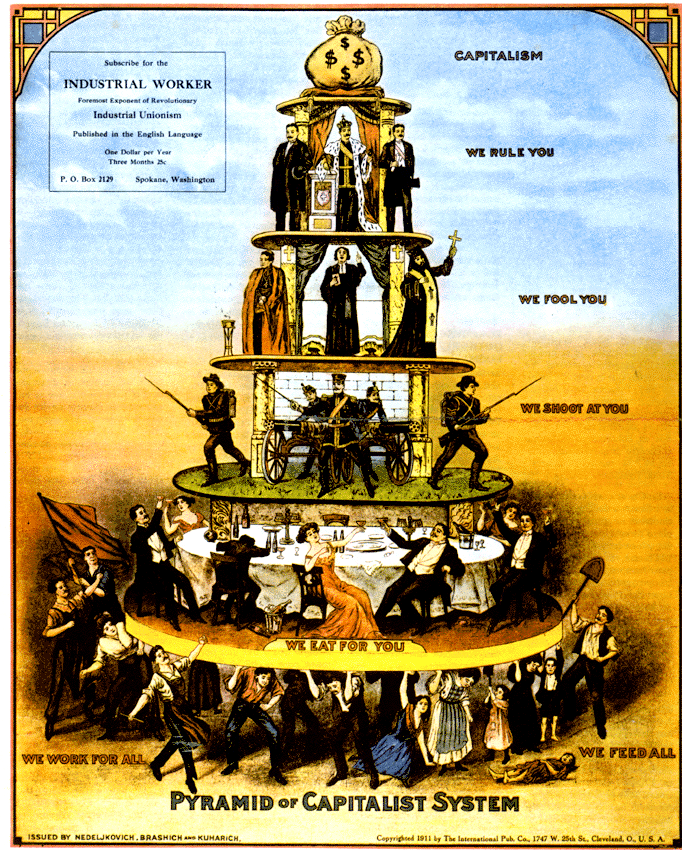
Pic of the Day: Capitalist Piggy Poster From 1911


From 1911 (h/t INC):


http://upstreampolitics.files.wordpress.com/2012/11/1911-anti-capitalism-poster2.gif


Would You Let Your Child Go Within 1,000 Miles Of This Man?


Jim Messina, former Obama campaign manager, National Chairman for OFA, and spearheader of the Obama agenda campaign


Pic of the Day: Jim Messina: "Kids Love Free Candy," M2RB:  Bozo the Clown


25 January 2013

Just Remember That He Is Only A Heartbeat Away...


A Drudge grand slam...


Gun Laws and the Fools of Chelm†


M2RB:  Billy Vera & The East Coast Beaters (lolz)


I can take care of myself
I don't need nobody's advice


"The individual is not only best qualified to provide his own personal defense, he is the only one qualified to do so."


By David Mamet

Karl Marx summed up Communism as “from each according to his ability, to each according to his needs.” This is a good, pithy saying, which, in practice, has succeeded in bringing, upon those under its sway, misery, poverty, rape, torture, slavery, and death.

‘In announcing his gun control proposals, President Obama said that he was not restricting Second Amendment rights, but allowing other constitutional rights to flourish.’

For the saying implies but does not name the effective agency of its supposed utopia. The agency is called “The State,” and the motto, fleshed out, for the benefit of the easily confused must read “The State will take from each according to his ability: the State will give to each according to his needs.” “Needs and abilities” are, of course, subjective. So the operative statement may be reduced to “the State shall take, the State shall give.”

All of us have had dealings with the State, and have found, to our chagrin, or, indeed, terror, that we were not dealing with well-meaning public servants or even with ideologues but with overworked, harried bureaucrats. These, as all bureaucrats, obtain and hold their jobs by complying with directions and suppressing the desire to employ initiative, compassion, or indeed, common sense. They are paid to follow orders.

Rule by bureaucrats and functionaries is an example of the first part of the Marxist equation: that the Government shall determine the individual’s abilities.

As rules by the Government are one-size-fits-all, any governmental determination of an individual’s abilities must be based on a bureaucratic assessment of the lowest possible denominator. The government, for example, has determined that black people (somehow) have fewer abilities than white people, and, so, must be given certain preferences. Anyone acquainted with both black and white people knows this assessment is not only absurd but monstrous. And yet it is the law.

President Obama, in his reelection campaign, referred frequently to the “needs” of himself and his opponent, alleging that each has more money than he “needs.”

But where in the Constitution is it written that the Government is in charge of determining “needs”? And note that the president did not say “I have more money than I need,” but “You and I have more than we need.” Who elected him to speak for another citizen?

It is not the constitutional prerogative of the Government to determine needs. One person may need (or want) more leisure, another more work; one more adventure, another more security, and so on. It is this diversity that makes a country, indeed a state, a city, a church, or a family, healthy. “One-size-fits-all,” and that size determined by the State has a name, and that name is “slavery.”

The Founding Fathers, far from being ideologues, were not even politicians. They were an assortment of businessmen, writers, teachers, planters; men, in short, who knew something of the world, which is to say, of Human Nature. Their struggle to draft a set of rules acceptable to each other was based on the assumption that we human beings, in the mass, are no damned good—that we are biddable, easily confused, and that we may easily be motivated by a Politician, which is to say, a huckster, mounting a soapbox and inflaming our passions.

The Constitution’s drafters did not require a wag to teach them that power corrupts: they had experienced it in the person of King George. The American secession was announced by reference to his abuses of power: “He has obstructed the administration of Justice … he has made Judges dependant on his will alone … He has combined with others to subject us to a jurisdiction foreign to our Constitution, and unacknowledged by our Laws … He has erected a multitude of new offices, and sent hither swarms of officers to harass out people and to eat out their substance … imposed taxes upon us without our consent… [He has] fundamentally altered the forms of our government.”


Gun rights advocates rally in Harrisburg, Pennsylvania, Jan. 2013.

Who threatens American society most: law-abiding citizens or criminals?


This is a chillingly familiar set of grievances; and its recrudescence was foreseen by the Founders. They realized that King George was not an individual case, but the inevitable outcome of unfettered power; that any person or group with the power to tax, to form laws, and to enforce them by arms will default to dictatorship, absent the constant unflagging scrutiny of the governed, and their severe untempered insistence upon compliance with law.

The Founders recognized that Government is quite literally a necessary evil, that there must be opposition, between its various branches, and between political parties, for these are the only ways to temper the individual’s greed for power and the electorates’ desires for peace by submission to coercion or blandishment.

Healthy government, as that based upon our Constitution, is strife. It awakens anxiety, passion, fervor, and, indeed, hatred and chicanery, both in pursuit of private gain and of public good. Those who promise to relieve us of the burden through their personal or ideological excellence, those who claim to hold the Magic Beans, are simply confidence men. Their emergence is inevitable, and our individual opposition to and rejection of them, as they emerge, must be blunt and sure; if they are arrogant, willful, duplicitous, or simply wrong, they must be replaced, else they will consolidate power, and use the treasury to buy votes, and deprive us of our liberties. It was to guard us against this inevitable decay of government that the Constitution was written. Its purpose was and is not to enthrone a Government superior to an imperfect and confused electorate, but to protect us from such a government.

Many are opposed to private ownership of firearms, and their opposition comes under several heads. Their specific objections are answerable retail, but a wholesale response is that the Second Amendment guarantees the right of the citizens to keep and bear arms. On a lower level of abstraction, there are more than 2 million instances a year of the armed citizen deterring or stopping armed criminals; a number four times that of all crimes involving firearms.

The Left loves a phantom statistic that a firearm in the hands of a citizen is X times more likely to cause accidental damage than to be used in the prevention of crime, but what is there about criminals that ensures that their gun use is accident-free? If, indeed, a firearm were more dangerous to its possessors than to potential aggressors, would it not make sense for the government to arm all criminals, and let them accidentally shoot themselves? Is this absurd? Yes, and yet the government, of course, is arming criminals.

Violence by firearms is most prevalent in big cities with the strictest gun laws. In Chicago and Washington, D.C., for example, it is only the criminals who have guns, the law-abiding populace having been disarmed, and so crime runs riot.

Cities of similar size in Texas, Florida, Arizona, and elsewhere, which leave the citizen the right to keep and bear arms, guaranteed in the Constitution, typically are much safer. More legal guns equal less crime. What criminal would be foolish enough to rob a gun store? But the government alleges that the citizen does not need this or that gun, number of guns, or amount of ammunition.

But President Obama, it seems, does.

He has just passed a bill that extends to him and his family protection, around the clock and for life, by the Secret Service. He, evidently, feels that he is best qualified to determine his needs, and, of course, he is. As I am best qualified to determine mine.

For it is, again, only the Marxists who assert that the government, which is to say the busy, corrupted, and hypocritical fools most elected officials are (have you ever had lunch with one?) should regulate gun ownership based on its assessment of needs.

Q. Who “needs” an assault rifle?

A. No one outside the military and the police. I concur.

An assault weapon is that which used to be called a “submachine gun.” That is, a handheld long gun that will fire continuously as long as the trigger is held down.

These have been illegal in private hands (barring those collectors who have passed the stringent scrutiny of the Federal Government) since 1934. Outside these few legal possessors, there are none in private hands. They may be found in the hands of criminals. But criminals, let us reflect, by definition, are those who will not abide by the laws. What purpose will passing more laws serve?

My grandmother came from Russian Poland, near the Polish city of Chelm. Chelm was celebrated, by the Ashkenazi Jews, as the place where the fools dwelt. And my grandmother loved to tell the traditional stories of Chelm.

Its residents, for example, once decided that there was no point in having the sun shine during the day, when it was light out—it would be better should it shine at night, when it was dark. Similarly, we modern Solons delight in passing gun laws that, in their entirety, amount to “making crime illegal.”

What possible purpose in declaring schools “gun-free zones”? Who bringing a gun, with evil intent, into a school would be deterred by the sign?

Ah, but perhaps one, legally carrying a gun, might bring it into the school.


Obama family attending Easter church service

 
If President Obama determines a need to defend his family, why can’t we defend our own?


Good.

We need more armed citizens in the schools.

Walk down Madison Avenue in New York. Many posh stores have, on view, or behind a two-way mirror, an armed guard. Walk into most any pawnshop, jewelry story, currency exchange, gold store in the country, and there will be an armed guard nearby. Why? As currency, jewelry, gold are precious. Who complains about the presence of these armed guards? And is this wealth more precious than our children?

Apparently it is: for the Left adduces arguments against armed presence in the school but not in the wristwatch stores. Q. How many accidental shootings occurred last year in jewelry stores, or on any premises with armed security guards?

Why not then, for the love of God, have an armed presence in the schools? It could be done at the cost of a pistol (several hundred dollars), and a few hours of training (that’s all the security guards get). Why not offer teachers, administrators, custodians, a small extra stipend for completing a firearms-safety course and carrying a concealed weapon to school? The arguments to the contrary escape me.

Why do I specify concealed carry? As if the weapons are concealed, any potential malefactor must assume that anyone on the premises he means to disrupt may be armed—a deterrent of even attempted violence.

Yes, but we should check all applicants for firearms for a criminal record?

Anyone applying to purchase a handgun has, since 1968, filled out a form certifying he is not a fugitive from justice, a convicted criminal, or mentally deficient. These forms, tens and tens of millions of them, rest, conceivably, somewhere in the vast repository. How are they checked? Are they checked? By what agency, with what monies? The country is broke. Do we actually want another agency staffed by bureaucrats for whom there is no funding?

The police do not exist to protect the individual. They exist to cordon off the crime scene and attempt to apprehend the criminal. We individuals are guaranteed by the Constitution the right to self-defense. This right is not the Government’s to “award” us. They have never been granted it.

The so-called assault weapons ban is a hoax. It is a political appeal to the ignorant. The guns it supposedly banned have been illegal (as above) for 78 years. Did the ban make them “more” illegal? The ban addresses only the appearance of weapons, not their operation.

Will increased cosmetic measures make anyone safer? They, like all efforts at disarmament, will put the citizenry more at risk. Disarmament rests on the assumption that all people are good, and, basically, want the same things.

But if all people were basically good, why would we, increasingly, pass more and more elaborate laws?

The individual is not only best qualified to provide his own personal defense, he is the only one qualified to do so: and his right to do so is guaranteed by the Constitution.

President Obama seems to understand the Constitution as a “set of suggestions.” I cannot endorse his performance in office, but he wins my respect for taking those steps he deems necessary to ensure the safety of his family. Why would he want to prohibit me from doing the same?


† A city in eastern Poland.


I Can Take Care Of Myself - Billy Vera & The East Coast Beaters

Your wardrobe's purchased at the latest boutique
Your place is furnished like the President's suite
Your freezer's filled up with the finest of meat
Somehow you manage on a hundred a week

They say you like to feel white gold on your neck
They say when you make love you like to direct
And that new sports car you proceeded to wreck
They say I ought to ask who picked up the check

I can take care of myself
My friends all say I ought to think twice
I can take care of myself
I don't need nobody's advice
You're so nice

Attempts to charm you met with little success
I never met someone so hard to impress
Until one day by chance you saw my address
The next day you had on your lowest cut dress
(Repeat Chorus)

They could be correct in their judgment of you
Maybe you'll take me and make me a fool
But I'm a big boy and I know what to do
It might be worth it to wake up next to you
(Repeat Chorus)

I can take care of myself
I don't need nobody's advice
Oh I can take care of myself
I don't need nobody's advice
Yeah I can take care of myself

I don't need nobody's advice 


Hoisted On His Own Petard


M2RB:  The Who


Well, who are you? (Who are you? Who, who, who, who?)
Oh, who are you(Who are you? Who, who, who, who?)
Oh Tell me, who are you? (Who are you? Who, who, who, who?)
Oh, who the fuck are you?


Non, vous n'êtes pas l'état!


By Todd Gaziano

President Obama seems to take pleasure in acting unilaterally in matters that are properly shared with Congress, especially if his acting alone energizes his base and dispirits conservatives and others who cling to constitutional order. He may believe it is worth taking the risk that a court will overturn a few of his illegal actions. But what if a court does more than simply invalidate the actions themselves?

 Today, a unanimous ruling by a three-judge panel of the D.C. Circuit Court of Appeals struck down President Obama’s purported “recess appointments” of three members of the NLRB — and went further in rebuking the administration in three important respects.

First, today’s ruling is much broader than expected — it severely limits the president’s recess-appointment power. Two days after the illegal recess appointments were made, Ed Meese and I wrote an op-ed in the Washington Post explaining an important but narrow ground on which a court might overturn them. We also warned of the effects that litigation could have:

President Obama’s flagrant violation of the Constitution not only will damage relations with Congress for years to come but will ultimately weaken the office of the presidency. There eventually may be litigation over the illegal appointments, but it will be a failure of government if the political branches do not resolve this injustice before a court rules.

Our constitutional-law-professor-in-chief ignored this advice and is now hoist on his own petard. He is worse off than he was when he started, because the court’s ruling invalidates all appointments made during recesses that occur in the middle of a Senate session. Under the ruling, appointments will be possible only in the recesses between sessions of the Senate, which are unlikely to occur, at least until the end of this year, without unusual Senate action.

Moreover, two of the three judges also ruled on an even broader constitutional ground, holding that the vacancy to be filled must actually arise during such an intersession recess, not prior to that period. The third judge expressed no opinion on this last issue.

The second setback is that 13 months’ worth of rulings, regulations, and other actions by the NLRB are now in question, because without the illegal recess appointments the NLRB lacked a quorum to act during all that time. The White House is disputing this, or at least Jay Carney is trying to, but it is hard to see how today’s ruling is limited to “once case, one company.” The courts have doctrines that might ameliorate some harsh results regarding pay and such, but most of the board’s actions are at least in doubt. Thus, not only must the president secure proper Senate confirmation for these officials, but the NLRB likely must start over when it has a quorum.

The third setback for the administration is that many of the actions of the Consumer Financial Protection Board (CFPB) are in doubt as well. Richard Cordray, who received a purported recess appointment on the same day and in the same manner as the three invalid NLRB members, would have been the first head of that agency. Thus, no prior head of the agency could have made lawful delegations of authority. Moreover, the CFBP’s organic statute provides that no acting head may issue regulations. The eventual effect of today’s decision on pending and future CFPB actions will take many months to sort out, but the rest of the D.C. circuit is bound by the ruling today unless the entire appeals court (as opposed to the three-judge panel) or the Supreme Court reverses it.

Our unilateral president must take his unilateral medicine. The administration may appeal today’s loss to the entire D.C. court, but that is also dangerous, since there are other grounds on which the court might sustain the ruling, including the one Ed Meese and I presented in the piece linked to above. The solicitor general may have little choice but to use his office’s capital to seek Supreme Court review.

My prediction: The justices will take the case and may narrow the grounds for striking down the illegal appointments. But I don’t think a Supreme Court majority will see any pressing need to contort the Constitution to uphold these unilateral actions.


— Todd Gaziano is the director of the Center for Legal and Judicial Studies at the Heritage Foundation and a former lawyer in the Justice Department’s Office of Legal Counsel, which advises the president on recess-appointment matters.


Who Are You? - The Who


Who are you?

Who, who, who, who?

Who are you?

Who, who, who, who?

Who are you?

Who, who, who, who?

Who are you?

Who, who, who, who?


I woke up in a Soho doorway

A policeman knew my name

He said "You can go sleep at home tonight

If you can get up and walk away"


I staggered back to the underground

And the breeze blew back my hair

I remember throwin' punches around

And preachin' from my chair


Well, who are you? (Who are you? Who, who, who, who?)

I really wanna know (Who are you? Who, who, who, who?)

Tell me, who are you? (Who are you? Who, who, who, who?)

'Cause I really wanna know (Who are you? Who, who, who, who?)


I took the tube back out of town

Back to the Rollin' Pin

I felt a little like a dying clown

With a streak of Rin Tin Tin


I stretched back and I hiccoughed

And looked back on my busy day

Eleven hours in the Tin Pan

God, there's got to be another way


Well, who are you? (Who are you? Who, who, who, who?)

Oh, who are you(Who are you? Who, who, who, who?)

Oh Tell me, who are you? (Who are you? Who, who, who, who?)

Oh Who the fuck are you? (Who are you? Who, who, who, who?)


Who are you?

who are who are who are you x11


Who are you?

Who, who, who, who?

Who are you?

Who, who, who, who?

Who are you?

Who, who, who, who?

Who are you?

Who, who, who, who?


I really wanna know (Who are you? Who, who, who, who?)

I really wanna know (Who are you? Who, who, who, who?)

C'mon tell me who are you? (Who are you? Who, who, who, who?)

Oh, I really wanna know (Who are you? Who, who, who, who?)


I know there's a place you walked

Where love falls from the trees

My heart is like a broken cup

I only feel right on my knees


I spit out like a sewer hole

Yet still recieve your kiss

How can I measure up to anyone now

After such a love as this?


Well who are you? (Who are you? Who, who, who, who?)

tell me who are you? (Who are you? Who, who, who, who?)

oh, I really wanna know? (Who are you? Who, who, who, who?)

tell, tell me who are you? (Who are you? Who, who, who, who?)


I used to check my reflection

Jumping with my cheap guitar

I must of lost my direction

'Cause I ended up a superstar

One night I's in the board room affected by the human race

You can learn from my mistake but your posing in my glass again


well who are you? (Who are you? Who, who, who, who?)

tell me who are you? (Who are you? Who, who, who, who?)

oh, I really wanna know? (Who are you? Who, who, who, who?)

tell, tell me who are you? (Who are you? Who, who, who, who?)


C'mon, c'mon who? (Who are you? Who, who, who, who?)

Oh, Who the fuck are you? (Who are you? Who, who, who, who?)

Who are you? (Who are you? Who, who, who, who?)

Oh, tell me who are you (Who are you?, ooo?)


I really wanna to know

Oh, I really want to know

C'mon tell me who are you, you, you?

Who are you?